Nov 21, 2026
Nov 21, 2026
A Critical Review of Solitude and Other Poems
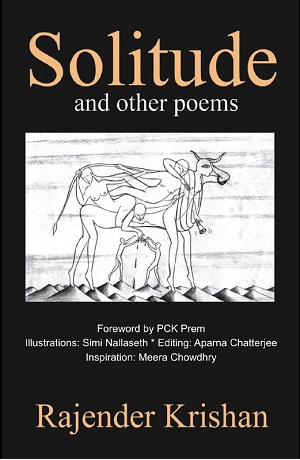 Rajender Krishan’s Solitude and Other Poems is a collection of philosophical inquiry, emotional intimacy and social unease. Bringing together poems composed across a number of years, some dating back to the late 1990s, the volume reveals a writer engaged in a continuing examination of existence and the human condition. Its central preoccupation is not solitude in the conventional sense of physical isolation, but the relationship between the restless mind, the observing consciousness and the world in which both participate.
The collection traverses four broad territories: self-discovery, thematic and metaphysical exploration, love, and social anxiety. These are not independent compartments. They overlap, contradict and illuminate one another, revealing a poetic temperament that moves between contemplation and participation, detachment and affection, spiritual conviction and worldly disquiet.
The resulting work is intellectually ambitious, emotionally sincere and stylistically uneven. Its most compelling poems transform ordinary experience into discovery; its less successful compositions occasionally mistake philosophical explanation or moral assertion for poetic revelation.
The Search for the Self
The philosophical foundation of the collection emerges almost immediately in Core of the Onion. The act of peeling an onion becomes a metaphor for stripping away the accumulated layers of identity. As the tangible object disappears, the poet encounters the paradox of apparent nothingness concealing an intangible presence.
The metaphor is effective because it begins with a familiar sensory experience. The piercing smell, the tears and the gradual removal of layers establish a physical reality before introducing a metaphysical proposition. Yet the concluding identification with the indestructible Atman also reveals a recurring limitation: the poet sometimes names the philosophical destination before the image has exhausted its possibilities.
The title poem, Solitude, provides a more expansive statement of the collection’s underlying concerns. The mind moves incessantly among contradictory thoughts and emotions, yet the witnessing consciousness remains undisturbed. The contrast between mental turbulence and inward stillness is central to Rajender’s understanding of existence. Solitude, therefore, is neither loneliness nor withdrawal. It is the condition in which consciousness becomes aware of its own activity without necessarily identifying with it.
This distinction recurs in Freedom, Mirror, Dominance, Tat Tvam Asi and What I Am?. Together, these poems question the identities constructed through relationships, possessions, thoughts, social expectations and personal ambitions. Among them, What I Am? is particularly successful. Rather than accepting identity as a settled proposition, the poem subjects it to sustained interrogation. Even the apparent certainty of individual existence becomes questionable. Its concluding uncertainty is more persuasive than a definitive metaphysical answer might have been. The poem demonstrates that philosophical poetry often achieves its greatest force not by resolving a mystery but by making the mystery more immediate.
The Poet and the Philosopher
Rajender’s poetic imagination is strongly influenced by Indian philosophical traditions, particularly concepts associated with Vedanta, karma, Maya, liberation and the relationship between the individual and universal consciousness. Such influences are neither decorative nor incidental. They provide the conceptual vocabulary through which the poet interprets experience.
Breath considers the vital force that sustains existence without recognizing the artificial divisions of caste, creed or ideology. The apparent freedom of the lifeforce becomes a contrast to the social restrictions imposed upon human beings.
Here and Now explores the psychological captivity produced by attachment to the past and anticipation of the future. Blessed is the Emptiness approaches emptiness not as deprivation but as the possibility of fulfillment and discovery. These poems exhibit conceptual clarity and a genuine desire to connect metaphysical thought with everyday existence.
Nevertheless, philosophical conviction does not invariably produce poetic intensity.
Several compositions proceed from an established proposition toward an anticipated conclusion. The reader is guided toward understanding rather than invited to participate in discovery. Abstract nouns and explanatory passages sometimes replace the suggestive power of imagery. The distinction is crucial. Philosophy seeks conceptual understanding; poetry must also create an experience of that understanding. Rajender is most effective when the two processes converge naturally.
Love, Intimacy and the Dissolution of Separateness
The love poems introduce another dimension to the collection’s exploration of identity. Here the self is no longer examined exclusively through inward contemplation. It is discovered, challenged and sometimes dissolved through relationship with another person. Relationship, Who is Valentine? and Sandbanks explore the paradox of individuality within union. The lover and beloved retain their distinct identities while discovering a deeper continuity that questions the permanence of separation.
Rajender also approaches physical intimacy without treating sensual experience as incompatible with spiritual realization. In Intercourse, Immersion and Nirvana, bodily union becomes associated with the disappearance of duality. Erotic experience and metaphysical language occupy the same imaginative territory.
The approach is philosophically coherent within the collection’s larger concerns. Its poetic success, however, varies. At times, the metaphysical vocabulary enriches sensual experience; elsewhere, it risks transforming intimacy into an illustration of a predetermined doctrine. The more personal love poems often achieve greater emotional resonance.
Reflections, commemorating a long marital relationship, gains particular distinction through the inclusion of the wife’s answering poem. This unusual dialogic structure allows the beloved to emerge as an independent consciousness rather than merely the subject of the poet’s affection.
The exchange suggests that identity is not discovered exclusively through introspection. It is also shaped through the perceptions, affections and responses of others.
The Unforgettable offers perhaps the collection’s finest demonstration of emotional restraint. A telephone conversation after decades of separation becomes an encounter in which silence communicates more than speech. The poem does not attempt to define every emotion contained within that silence. Memory, longing, hesitation and unspoken affection remain suspended between the participants. Its achievement lies in recognizing that emotional truth need not always be explained.
Nature as Metaphor and Teacher
Nature occupies an important position in Rajender’s poetry. Rivers, oceans, birds, trees, seasons, sunlight and storms are recurring presences. They provide both the imagery and the philosophical structure through which human experience is interpreted.
In Deluge, natural forces create a dynamic interplay of destruction, renewal and movement. Sandbanks transforms geographical separation into a meditation on underlying continuity. Love is in the Air discovers renewal through seasonal transformation.
These poems frequently treat nature as an expression of processes that human beings experience inwardly.
The approach becomes particularly affecting in Migratory Birds. The natural migration of birds, followed by their instinctive return, is contrasted with the psychological complexities of human migration. The speaker has established a chosen existence elsewhere but remains troubled by the emotional consequences of leaving the homeland. The poem avoids reducing migration to either liberation or exile. The new life represents achievement, while the old homeland continues to exert its influence. Its concluding image of an eagle unable to fly again is particularly poignant. The creature associated with freedom becomes an emblem of psychological immobility. Here the metaphor is allowed to retain its contradictions, giving the poem a depth that more explicit philosophical conclusions sometimes diminish.
The Social Conscience
The collection’s movement toward social concerns is both substantial and revealing.
Physics & Social Chemistry offers a conceptual bridge between the poet’s metaphysical and social interests. The orderly movements of the universe are contrasted with the divisions created by human institutions, beliefs and ambitions. The underlying argument is that a world sustained by interconnected natural processes is repeatedly fragmented by human prejudice and possessiveness. This concern becomes increasingly pronounced in poems addressing political hypocrisy, exploitation, poverty, violence, ecological destruction, gender injustice and institutional failure.
Struggling Workers is especially effective when it concentrates on the concrete circumstances of ordinary lives. The exhaustion of labour and the fragile domestic world awaiting the worker communicate economic vulnerability more convincingly than generalized denunciations.
A Hindu Obligation is among the collection’s strongest socially conscious poems. A dying man recognizes the environmental consequences of religious practices in which he himself has participated. His desire to plant a sapling transforms moral realization into a simple, meaningful act. The poem succeeds because its criticism begins with self-examination rather than accusation.
Politics demonstrates a comparable economy. A grandfather instructs his granddaughter in moral conduct but casually asks his wife to lie about his presence at home. The contradiction exposes the everyday foundations of political dishonesty. The domestic incident achieves what a lengthy denunciation of public corruption might fail to accomplish.
Both poems reveal an important strength in Rajender’s social writing: the ability to locate universal ethical questions within ordinary human behavior.
Other compositions are less successful in maintaining this balance.
Mortification, Kill the Devil, Overpopulation and Misanthropists are animated by unmistakable moral urgency, but their rhetorical intensity sometimes overwhelms poetic complexity. Broad accusations, emphatic judgments and accumulations of abstract terms can diminish the individuality of the experiences being examined.
The poems addressing violence against women, including Wolves and Nirbhaya: The Prologue of Change, emerge from genuine outrage. Their historical and ethical concerns are substantial. Yet the language occasionally becomes so declarative that the poems approach public statements rather than sustained imaginative exploration. Death in Kindergarten, responding to the Sandy Hook tragedy, illustrates a related difficulty. Its grief and indignation are understandable, but the suggestion of a simplified causal explanation for extreme violence weakens an otherwise serious moral inquiry.
Poetry can illuminate social suffering without claiming to resolve every cause. Rajender’s strongest social poems demonstrate precisely that capacity.
Language, Form and Poetic Discipline
The collection is dominated by free verse, often arranged in short lines that emphasize individual words, contrasts and philosophical propositions. The diction is generally accessible, and the poet seldom pursues obscurity as an aesthetic objective. His preference is for communication, frequently through direct statements and recognizable metaphors. This accessibility is valuable, especially when the poems address unfamiliar philosophical concepts.
Nevertheless, directness occasionally becomes overstatement. Repetition, emphatic capitalization, explanatory footnotes and rhetorical conclusions sometimes reduce the interpretive freedom available to the reader. In certain poems, the central insight is expressed effectively and then reiterated in language that adds little to its imaginative force. Conversely, some passages employ unnecessarily elaborate diction where simpler language would have been more precise.
The collection also contains occasional rhymed compositions whose formal regularity does not always complement their subject matter. Particularly in poems addressing serious social problems, rhyme can impose an artificial neatness upon experiences that demand greater emotional and intellectual complexity. These weaknesses are not universal. Indeed, the contrast between the collection’s more heavily explained poems and its restrained compositions is striking.
Predator, Politics and The Unforgettable demonstrate how effectively Rajender can work through compression, incident and implication. Their success suggests that poetic discipline, rather than philosophical elaboration, is often the decisive element in his strongest writing.
The Observer and the Participant
One of the collection’s most interesting contradictions concerns the relationship between detachment and involvement.
The philosophical poems repeatedly seek freedom from identification, desire, ego and the disturbances of the mind.
The social poems, by contrast, are deeply involved in the injustices and anxieties of the world.
The love poems celebrate attachment even while exploring the dissolution of separateness.
These positions might initially appear inconsistent. Yet their coexistence gives the collection much of its character. The poet who seeks detachment cannot remain indifferent to suffering. The observer who questions personal identity continues to participate in relationships. The consciousness that aspires toward universality encounters a society fractured by distinctions of religion, class, nationality and power.
Solitude therefore becomes not an escape from the world but a position from which the world can be examined more intensely. The collection’s most productive tension lies between the desire to transcend human limitations and the refusal to disregard human experience.
An Evolving Poetic Consciousness
Because Solitude and Other Poems brings together writing from different years, its variations in style and method should not be mistaken for the characteristics of a single creative period. The collection offers evidence of differing approaches to poetic expression, although the absence of a comprehensive chronology for individual poems prevents a definitive account of stylistic development.
What can be observed is a range of poetic methods.
The collection is most convincing when experience is permitted to challenge an established belief rather than merely confirm it. This distinction is especially apparent when What I Am?, The Unforgettable, Politics and Migratory Birds are considered alongside the more declarative philosophical and social compositions. In the former, the reader encounters a question, a silence, a contradiction or an unresolved emotional condition. The poem creates a space in which understanding can emerge. In the latter, the conclusion sometimes precedes the imaginative experience. The difference is not between spiritual and secular subjects, nor between private and public concerns. It is fundamentally a difference in poetic method.
Critical Assessment
Solitude and Other Poems is distinguished by its breadth of concern and the sincerity of its inquiry. Rajender is unwilling to separate philosophical reflection from emotional life or personal experience from social responsibility. The collection’s strongest qualities include its recurring metaphors of consciousness and continuity, its willingness to explore the relationship between sensuality and spirituality, its humane concern for social suffering, and its capacity to discover ethical significance in ordinary incidents. Its principal limitations arise from excessive explanation, occasional rhetorical generalization, uneven diction and a tendency to conclude philosophical inquiries before their imaginative possibilities have been fully explored.
The book is therefore not uniformly accomplished, but neither is its unevenness without significance. It reveals a writer testing different ways of bringing experience, conviction and expression into relationships. Its finest poems demonstrate that the author’s philosophical and moral concerns need not be diminished to achieve greater poetic power. They become more compelling when entrusted to image, incident, contradiction and silence.
Conclusion
The significance of Solitude and Other Poems lies less in the originality of its philosophical propositions than in the persistent effort to examine those propositions through lived experience. Its poetry moves between the inward search for identity and the outward encounter with love, nature and society. The individual consciousness repeatedly discovers that self-understanding cannot be separated from relationships or from the larger human condition. The collection’s central paradox is that solitude becomes meaningful precisely because existence is interconnected.
The observer is never entirely separate from the observed. The seeker cannot escape the world in which the search takes place. And the poet, even while seeking silence, must work through language to approach it. At its most accomplished, Solitude and Other Poems recognizes that poetry need not provide a final answer to every question it raises. Its deepest achievement emerges when philosophical conviction gives way to attentive observation, when moral urgency becomes human experience, and when explanation yields to discovery.
The collection is ultimately not a declaration of what the self is, but an exploration of what remains when the self begins to question its own certainties.
Updated - Originally submitted by author in March, 2020.
21-Nov-2026
More by : Papa Rao Jayanthi
Top | Book Reviews | Home
