|
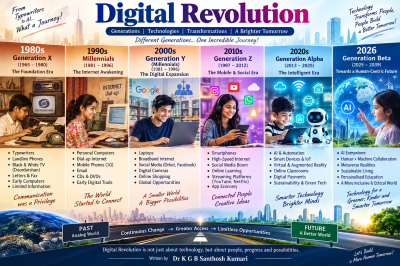
A Millennial’s Journey from Typewriters to AI
I was born in 1982—
when a phone was something
that stayed on a table,
a photograph was something
you waited to develop,
and “going online”
meant nothing more than
going somewhere.
I was born into a world
that moved slowly—
but somehow,
we never felt we were missing anything.
There was no Google
to answer my questions.
There was no GPS
to tell me where I was.
There was no WhatsApp
to ask, “Where are you?”
If someone wanted to know
where I was,
they simply waited
for me to come home.
And somehow—
I did.
The Childhood Of 1982
My childhood had
the comforting soundtrack of the times:
Tring… tring…
the telephone ringing
from another room.
Tick-tick… tick-tick…
the wall clock reminding us
that time was actually
something we watched pass.
Chrrrr… chrrrr…
the ceiling fan turning lazily
above our summer afternoons.
And somewhere nearby—
Krrrr… krrrr…
the radio searching
for the right station.
Radio was our podcast.
Television was our streaming service.
The newspaper was our news app.
The library was our search engine.
And the elders in the family—
well, they were Google before Google.
If I asked,
“Why is the sky blue?”
someone would confidently answer.
If I asked another question,
the answer would somehow become,
“Go study first!”
That was our original
parental search filter.
When Doordarshan Was The World
Then came television.
Not a giant screen.
Not smart.
Not 4K.
Not even remotely intelligent.
Just a box—
and yet,
what a box it was!
When Doordarshan came on,
the whole family gathered.
No one said,
“I'm watching something else.”
There was nothing else.
No Netflix.
No YouTube.
No scrolling.
No skipping advertisements.
We watched what was scheduled
and learned the ancient art of waiting.
Shhhhhh…
the television settled into its picture.
Sometimes the signal disappeared.
Sometimes the picture rolled.
Sometimes someone shouted,
“Adjust the antenna!”
And a family member would climb up
or move the antenna,
while everyone else shouted directions:
“Little left!”
“No, no—right!”
“Stop!”
“Ah! There!”
And suddenly—
magic!
A picture appeared.
Today we call it Troubleshooting.
Back then,
we simply called it Family Teamwork.
The Sound Of A Cassette
Music came on cassettes.
Two little wheels
holding an entire emotional universe.
Click.
Play.
Whirr… whirr…
Sometimes the tape got stuck.
Sometimes the cassette
was swallowed by the player.
And out came the legendary tool—
the pencil.
Round and round
we rewound our favourite songs.
No playlist.
No shuffle.
No algorithm saying,
“Because you listened to this…”
We chose our own songs.
And perhaps that is why
we remember them so well.
We didn't just listen to music.
We waited for it.
We searched for it.
We shared it.
We remembered it.
School Without Google
School was another world.
Homework meant
books, notebooks and handwriting.
If I didn't know an answer,
I couldn't type it into a search box.
I had to ask a teacher,
look through a textbook,
visit a library,
or search through an encyclopedia.
Research meant—
turning pages.
Page after page.
Flip… flip… flip…
There was something beautiful
about discovering an answer
after looking for it.
Our notebooks had margins.
Our pens had personalities.
Our handwriting revealed our moods.
And mistakes stayed there—
red ink circling them—
because there was no
Ctrl + Z.
Perhaps that taught us
something technology sometimes forgets:
Mistakes are part of learning.
The Telephone Was A Family Event
A telephone call was special.
Especially a long-distance call.
Sometimes we waited
for the telephone to ring.
Tring… tring… tring…
And when it finally did,
everyone wanted to know—
“Who is calling?”
There was no caller ID.
No profile picture.
No status saying Busy.
No blue ticks.
You simply answered:
“Hello?”
And the voice at the other end
was enough.
No emoji was needed
to know whether someone was smiling.
No typing indicator
was needed to know
someone was thinking.
We listened.
Really listened.
Letters Had Weight
And then there were letters.
Paper.
Ink.
An envelope.
A stamp.
A journey.
Scratch… scratch…
as a pen moved across paper.
A letter could take days
to arrive—
but when it did,
you held it.
Read it.
Read it again.
Sometimes you kept it
inside a book.
Years later,
the paper itself
could bring back a voice.
Today a message can be deleted
in one second.
Back then,
a letter could survive
for decades.
We called it snail mail later.
But honestly,
the snail was never the problem.
We simply had to learn
the beautiful art of patience.
The First Glimpse Of The Digital World
Then, slowly,
the world began to change.
Computers appeared.
At first,
they looked enormous—
more furniture than machine.
Click… clack… click…
The keyboard became
the new typewriter.
The monitor glowed.
The cursor blinked.
Blink… blink… blink…
And I remember that feeling—
the strange excitement
of watching technology
do something that once seemed impossible.
Then came floppy disks.
Tiny in size,
enormous in importance.
We trusted them
with our precious files.
Until one day—
Error.
And suddenly,
the floppy became
a very expensive lesson
in not trusting technology completely.
The Internet Arrives
Then came the Internet.
And I still remember
the sound of connecting.
Dial… dial…
Beep…
Screeeeeech…
Bzzzzzzzz…
That terrible, wonderful sound
was the door opening
to another world.
The internet was slow.
Painfully slow.
But we were patient.
Why?
Because we had grown up
waiting for letters.
Waiting for television programmes.
Waiting for telephone calls.
Waiting for photographs
to be developed.
So waiting for a webpage
was nothing new.
Then suddenly—
the world was there.
Information.
People.
Places.
Possibilities.
The world had become smaller.
But our curiosity
had become bigger.
From Orkut To Instagram
Then came email.
Send.
No envelope.
No stamp.
No postman.
Just a click.
Then social media arrived.
Orkut.
Facebook.
WhatsApp.
Instagram.
And our lives slowly moved
from albums to timelines.
We stopped saying,
“Come and see my photographs.”
We started saying,
“Like my photographs.”
We gained followers—
and discovered that
having followers
doesn't always mean
having someone to follow you
when life gets difficult.
That was another digital pun:
We became more connected
and sometimes less connected.
The Smartphone That Became Too Smart
Then came the smartphone.
One little rectangle
became everything:
telephone,
camera,
calculator,
map,
calendar,
bank,
library,
classroom,
office,
entertainment,
shopping centre,
and alarm clock.
Ping!
Message.
Ping!
Email.
Ping!
News.
Ping!
Social media.
Ping! Ping! Ping!
And somewhere along the way,
I realised—
the phone was supposed
to be smart,
but it was making me
check it every five minutes.
Technology promised
to save time.
Yet somehow,
I had less time.
It promised connection.
Yet sometimes,
at the dinner table,
everyone was looking at a screen
instead of looking at each other.
The smartphone became
a window to the world—
and sometimes,
a wall between people
sitting in the same room.
2020: The Screen Became The Room
Then came a strange chapter.
The classroom became a screen.
The office became a screen.
The meeting became a screen.
The world became a screen.
And suddenly,
the most important sentence
of professional life was:
“You’re on mute.”
We laughed about it.
But underneath the laughter,
we were learning something serious.
Technology could bring
the whole world into our homes—
but it could also
bring the whole world of work
into our homes.
The boundary disappeared.
Work entered breakfast.
Meetings entered bedrooms.
Notifications entered sleep.
And silence became a luxury.
2026: I Become A Student Again
And now—
2026.
I am no longer the girl
who was amazed by her first computer.
I am the woman
who knows she must keep learning.
The technology has changed again.
AI has entered the room.
It writes.
It analyses.
It translates.
It creates.
It teaches.
It predicts.
It assists.
And I have realised something important:
The future does not belong
only to the young.
It belongs to those
willing to keep learning.
So I update.
I upgrade.
I upskill.
I reskill.
I unlearn.
I relearn.
Every new tool
makes me a beginner again.
And strangely—
I don't mind.
Because I remember
being the girl of 1982
who thought a computer
was almost magical.
I still have that curiosity.
Only the magic has become
much more powerful.
But What Are We Losing?
Yet sometimes I wonder—
what price are we paying
for all this convenience?
Our attention is being harvested.
Our habits are being predicted.
Our preferences are being tracked.
Our faces are recognised.
Our voices are recorded.
Our choices become data.
And the most valuable thing
we give technology
may not be our money.
It may be—
our attention.
Scroll…
Swipe…
Like…
Share…
Refresh…
Again.
Again.
Again.
We don't always choose
what we watch anymore.
Sometimes the algorithm chooses
what watches us.
That is the great irony:
We created technology
to control information—
and now information
sometimes controls us.
And Then I Imagine 2050
What happens when
the Digital Revolution turns 2050?
Perhaps there will be
no screens at all.
Our glasses may become computers.
Our homes may anticipate
what we need.
Cars may drive themselves.
Robots may cook.
AI may teach our children.
Virtual reality may become
almost indistinguishable
from reality.
A doctor may diagnose illness
before we feel sick.
A teacher may have
a personalised AI assistant
for every student.
A machine may translate
every language instantly.
A digital companion
may know our habits,
our memories,
our preferences,
perhaps even
our moods.
And my granddaughter
may ask me:
“Grandma,
did you really have to
type things with your fingers?”
I will laugh.
“Yes.”
“Did you really have
to carry a phone?”
“Yes.”
“Did you really have
to search for information?”
“Yes.”
She may look at me
the way I once looked
at a cassette tape.
And then she may ask
the question that matters:
“Grandma,
with all that technology,
were people happier?”
And I may not know
how to answer.
The Danger Of Being Too Connected
Because by 2050,
we might have
smarter machines
but shorter attention spans,
more information
but less wisdom,
more followers
but fewer friends,
more virtual experiences
but fewer real experiences,
perfect photographs
but imperfect memories.
The biggest problem
may not be artificial intelligence.
It may be artificial attention.
Buzz…
Ping…
Blink…
Scroll…
Our lives could become
one enormous notification.
And human beings—
the ones who invented
the technology—
may become the ones
waiting to be notified.
So What Should 2050 Look Like?
I don't want a future
where technology replaces humanity.
I want technology
that reveals humanity.
Let AI make us faster—
but let wisdom make us better.
Let machines do more—
so humans can be more.
Let algorithms find patterns—
while people find meaning.
Let robots perform tasks—
while humans build relationships.
Let technology connect continents—
without disconnecting families.
Let innovation create convenience—
without stealing our attention.
Because a machine can recognise
my face in a crowd.
But I want a human being
to recognise when I am hurting.
A machine can generate
a thousand poems.
But I want someone
to understand the one poem
I cannot say aloud.
A machine can remember
everything I have searched.
But I want someone
to remember what matters to me.
I Am The Girl Of 1982
I am the girl of 1982—
who grew up with
letters,
landlines,
Doordarshan,
cassettes,
typewriters,
libraries,
film cameras,
floppy disks,
and handwritten dreams.
I became the woman of 2026—
with
smartphones,
clouds,
social media,
online learning,
digital payments,
video meetings,
and AI.
I have travelled
from typewriter to touchscreen,
from landline to lifeline,
from floppy to cloud,
from Google to generative AI.
I have heard the soundtrack
of every technological age:
Tring…
Click…
Clack…
Beep…
Bzzzz…
Ping…
Swipe…
Scroll…
Generate…
And now I wonder—
what sound will 2050 make?
Perhaps no sound at all.
Perhaps technology
will become so invisible
that we won't hear it working.
But I hope—
amid the silence of intelligent machines—
we can still hear
children laughing,
friends talking,
parents calling,
birds singing,
pages turning,
and human hearts
beating beside one another.
Because after all these years,
I have learned something
technology can never upgrade:
being human.
So I will keep learning.
Keep questioning.
Keep updating.
Keep upskilling.
Keep adapting.
But I will also keep
looking into someone's eyes,
listening without a screen,
writing words with feeling,
laughing without an emoji,
remembering without a cloud,
and holding a hand
without Bluetooth.
Because technology may change
the way we live—
but we must decide
what makes life worth living.
And when 2050 arrives,
I hope the future does not say—
“Humans became obsolete.”
I hope it says—
“Humans became wiser.”
For I was born
when technology was something
we used.
I have lived to see
technology become something
we live with.
And perhaps by 2050,
our greatest achievement
will be learning
how to live with technology
without forgetting
how to live with one another.
Because the greatest revolution
was never digital.
It was always—
HUMAN.
Image Copyright - Dr. KGB Santhosh Kumari |
