Nov 28, 2026
Nov 28, 2026

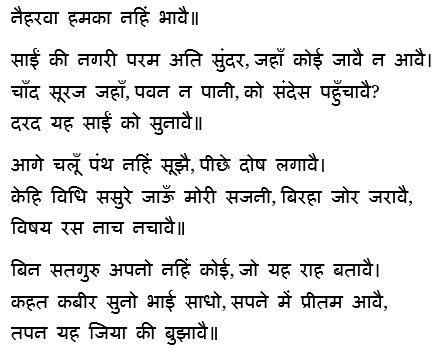
Naiharva Humka Nahin Bhave
Sayeen Ki Nagari Param Ati Sundar, Jahan Koi Jaave Na Aave.
Chand Suraj Jahan, Pavan Na Paani, Ko Sandesh Pahunchave?
Darad Yeh Sayeen Ko Sunave.
Aage Chalun Panth Nahin Soojhe, Peechhe Dosh Lagave.
Kehi Vidhi Sasure Jaaun Mori Sajani, Birha Jor Jarave,
Vishay Ras Naach Nachave.
Bin Satguru Apno Nahin Koi, Jo Yeh Raah Batave.
Kahat Kabir Suno Bhai Sadho, Supne Mein Preetam Aave,
Tapan Yeh Jiya Ki Bujhave.
Translation
My parental home no longer appeals to me.
Exceedingly beautiful is the abode of my beloved,
Where none comes or goes.
There is neither moon nor sun, neither wind nor water.
Who shall carry my message
And convey my anguish to my beloved?
I wish to proceed, but cannot discern the path;
If I turn back, I invite blame.
How shall I reach my marital home, my dear friend?
The pangs of separation consume me,
The attractions of desire make me dance in turbulence.
None but the Satguru is truly my own,
Who can show me the way.
Says Kabir, listen, O seekers:
May my beloved visit me in a dream
And soothe the burning anguish of my heart.
My Understanding
Kabir portrays a married woman visiting her parental home. Having spent a few days amidst the affection of her parents, siblings and childhood companions, she begins to miss her beloved. The surroundings have not changed, nor has the affection of her family diminished. Yet, her parental home no longer holds the same appeal.
She reminisces about the beauty of her beloved's abode, where their intimacy remains undisturbed. In Kabir's times, even a journey of a few miles between villages could be arduous and hazardous. However, when viewed from the perspective of a devotee, the distance is no longer geographical. The abode of the beloved is perceived as a realm beyond the reach of the physical elements.
The devotee knows the beloved, has perceived the beauty of His abode and comprehends the distance, yet finds no means of conveying the anguish of separation.
Viraha itself becomes a prayer.
The woman wishes to return to her marital home but cannot discern the path ahead, while turning back would invite blame. She confides in her companion, expressing her helplessness. The joy of anticipating a reunion and the anguish of being unable to reach her beloved generate turbulence within her.
The predicament of the devotee is similar. Having perceived the beauty of the beloved's abode, the former way of living no longer appeals, while the path towards the desired state of being remains obscure.
It is here that Kabir introduces the significance of the Satguru — one who understands the nature of Existence and can offer appropriate counsel.
The Satguru neither dismisses her yearning nor promises its fulfillment. Instead, he reveals a possibility: if she cannot reach her beloved, the beloved may visit her in a dream.
Heeding this counsel, she begins to contemplate the possibility and rationalize her predicament. Whether or not the dream actually occurs becomes secondary. The very contemplation of its possibility brings solace to her troubled heart.
The separation remains, but its torment subsides. The wisdom of the Satguru lies in enabling her to find relief without altering the prevailing circumstances.
We may not be able to change a situation, but we can still change our attitude towards it.
More by : Rajender Krishan
Top | Love Songs | Home