Nov 26, 2026
Nov 26, 2026

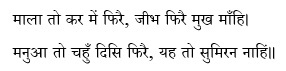
Mala To Kar Mein Phire, Jeebh Phire Mukh Mahin
Manua To Chahun Disi Phire, Yeh to Sumiran Nahin
Translation
The rosary turns in the hand,
the tongue moves within the mouth,
While the mind wanders in all directions
— this is not Sumiran.
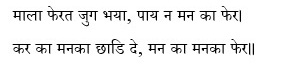
Mala Ferat Jug Bhaya, Payey Na Man Ka Pher
Kar Ka Manka Chhad De, Man Ka Manka Pher
Translation
A lifetime spent turning the beads,
yet the workings of the mind remain undiscovered.
Leave aside the beads in your hand;
turn your attention to the workings of your mind.
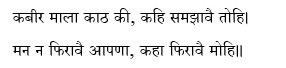
Kabir Mala Kath Ki, Kahi Samjhavey Tohi
Man Na Phirave Apna, Kaha Phirave Mohi
Translation
Kabir, the wooden rosary
what does it itself explain to you:
Paying no attention to the workings of your mind,
why do you keep turning me?
My Understanding
Sumiran, in its literal sense, means remembrance. In religious practice, it is generally associated with remembering the Divine and is regarded as a form of worship. In practical terms, however, Sumiran is about being focused.
I recall watching Amma cook. She seldom needed a spoon or a weighing scale to measure the quantity of salt or spices. Her fingers served the purpose, and when cooking in larger quantities, her palm came in handy. The proportions were invariably right. Yet, if her attention were elsewhere, even though sheer habit and years of experience ensured the correct proportions of ingredients and spices, the food might not carry Amma's trademark taste. It might even be overcooked or undercooked.
What made the difference? Her attention to what she was doing — the love that went into her cooking. She was attentive to the changing color, the emerging aroma, the consistency of the ingredients and the intensity of the flame. Her experience enabled her to respond spontaneously to the requirements of the moment. Amma's cooking itself, in a focused state, was Sumiran.
We often hear the expression, Work is Worship. Perhaps its significance lies not merely in the work we undertake but in the manner in which we undertake it. A cobbler repairing a shoe, a farmer tilling the soil, a carpenter shaping a piece of wood or a child engrossed in drawing a picture — each has the opportunity to experience Sumiran in the very course of living. Work, any worthwhile work, undertaken with focus, becomes worship.
However, remaining focused is not always easy. The mind tends to wander. While reading a book, we may suddenly discover that we have turned several pages without comprehending what we have read. While listening to someone, we may already be preparing our response instead of attending to what is being said.
Our eyes, ears, hands and tongue may be engaged in an activity while our mind is occupied elsewhere. How familiar is this predicament! Kabir draws our attention to these vagaries of the mind.
Understanding the mind, however, is not necessarily the same as stilling the mind. A Yogi may, through disciplined practice, develop such concentration that wandering thoughts either find no opportunity to intrude or pass by without disturbing the focus.
But what about an individual engaged in the numerous activities of everyday life? Can such an individual remain an active participant in life and yet be a witness to the oscillations of the mind?
Suppose someone makes an unpleasant remark. Observe how swiftly the mind begins its activities. It recalls previous encounters, imagines intentions, constructs arguments and prepares a suitable response, all within moments. Must we necessarily act upon everything that the mind generates?
Being aware of these movements allows us to exercise discretion. Viveka — our faculty of discrimination — becomes the guard. Interestingly, we do not require an external instrument to observe these movements. Nor is there an outsider monitoring the activities of our mind. It is the Mind itself minding the mind's business.
Perhaps the time, energy and concentration we devote to turning the beads of a rosary could also be devoted to observing the movements of our mind, discovering its tendencies and gradually understanding its nature.
Kabir then introduces an interesting twist. He lets the wooden rosary itself question its user. When you are not attending to the workings of your mind, why do you keep turning me? This question has implications far beyond the practice of turning a rosary.
How often do we follow traditions without knowing the reasoning behind them? A practice may have originated from a practical necessity, a keen observation or the accumulated wisdom of generations. Over time, however, the practice may survive while the understanding behind it disappears.
When questioned, we often respond, “This is how it has always been done.”
We may even consider questioning a tradition an act of disrespect. But does an endeavor to understand what we have inherited constitute disrespect? Understanding the purpose of a tradition may enable us to appreciate it more deeply, adapt it to changing circumstances or recognize that it has outlived its utility. Neither blind adherence to a tradition nor its indiscriminate rejection demonstrates understanding. When the practice becomes more important than its purpose, the means has become the end.
Kabir need not be understood as advocating the abandonment of the rosary. Rather, he invites us to examine whether the practice is serving its intended purpose.
The beads are wooden. They have no mind of their own. Yet, through Kabir, they remind us to attend to the workings of ours. Whether we are turning the beads of a rosary, preparing a meal or attending to the countless responsibilities of everyday life, the opportunity for Sumiran is always available.
We need only discover it.
Beyond the beads lies the entire field of living.
Revisited and Updated: November 25, 2026
More by : Rajender Krishan

|
Is it possible for a common man to practice true meditation in today's world of materialism & hectic life style...?? In my view, there is no need of meditation or prayer for a person who is always busy in performing his duties towards his/her nation, employer, parents, wife & children. |
|
|
profound master |
|
|
excellent words.... really i appreciate kabeer |