Nov 26, 2026
Nov 26, 2026
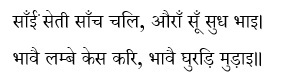
Saaeen Seti Saanch Chali, Auran Soon Sudh Bhai
Bhaavai Lambe Kes Kari, Bhaavai Ghuradi Mudaai
Translation
To connect with the Divine, be true to yourself,
Be truthful and caring in your dealings with others;
Wear your hair long,
Or shave your head — as you please.
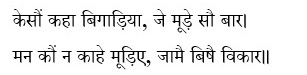
Kesoun Kaha Bigaadiya, Je Moode Sau Baar
Man Koun Na Kaahe Moodiye, Jaamai Bishai Vikaar
Translation
What wrong has your hair done
That you shave it a hundred times?
Why not cleanse (shave) the mind instead,
Which harbours desires and distortions?
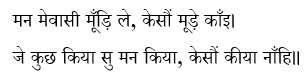
Man Mevasi Moondi Le, Kesoun Moode Kaain
Je Kuchh Kiya Su Man Kiya, Kesoun Keeya Naahin
Translation
Cleanse (shave) your dictatorial mind,
Why shave your hair?
Whatever happens is the mind's doing;
The hair does not participate.
Moond Mundaavat Din Gaye, Ajahoon Na Miliya Raam
Raam Naam Kahu Kya Karain, Je Man Ke Aure Kaam
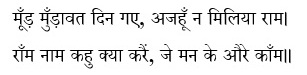
Translation
Days have passed shaving your head,
Yet union with the Divine remains unrealized.
What purpose does parroting the Divine Name serve,
When the mind is busy doing other things?
My Understanding
Kabir begins by addressing two fundamental aspects of living — being true to oneself and being truthful and caring in one's dealings with others. Having established these essentials, he leaves the choice of one's appearance entirely to the individual.
Whether we wear our hair long or shave our heads, dress simply or elaborately, is a matter of personal preference. Such choices may be influenced by culture, tradition, religious affiliation or even contemporary fashion. There is nothing inherently wrong with any of them. The question arises when we begin to associate our appearance with the quality of our being.
A person dressed in the attire of a saint may not necessarily be saintly, just as someone dressed in ordinary clothes need not be devoid of wisdom or compassion. Appearance may communicate an identity, but it cannot establish character. With characteristic humor, Kabir questions the wisdom of repeatedly shaving the hair while neglecting the mind.
The mind, like a vessel, has been accumulating impressions, experiences, desires, beliefs and prejudices over the years. Some of these enrich our lives, while others distort our perception and influence our conduct.
How often do we examine what we have been accumulating?
We readily notice a blemish on our face while looking into a mirror. We may spend considerable time and effort attending to it. Yet a prejudice that has been influencing our relationships for years may remain unnoticed, or worse, we may continue to justify it.
Cleansing the mind does not mean emptying it of everything it holds. It means examining its contents, recognizing the distortions and developing the discernment to distinguish what is worth nurturing from what needs to be discarded.
But Kabir takes us a step further.
The mind, with all that it has accumulated, can gradually assume dictatorial authority over us. Our likes and dislikes, convictions and prejudices, ambitions and fears may begin to dictate how we perceive people, respond to situations and conduct ourselves. We may even defend these responses without examining their origins.
Consider how often, in a disagreement, our concern shifts from understanding another person's point of view to establishing that we are right. The conversation may have begun with a sincere intention to resolve a problem, but the mind, pursuing its own agenda, turns it into a contest.
Who, then, is exercising authority?
The mind is a remarkable instrument available to us. Yet, without discernment, the instrument can become the master. Kabir's reference to the innocent hair brings home the absurdity of attending to something that has played no part in the distortions of our conduct. The same contradiction becomes apparent in our spiritual pursuits. We may aspire for union with the Divine while remaining unwilling to examine the very tendencies that perpetuate our sense of separateness. We may proclaim the oneness of existence while discriminating against fellow human beings. We may utter the name of the Beloved while harboring ill will towards others.
Our professed intentions and our actual preoccupations may be entirely different.
Being true to oneself requires recognizing this contradiction without seeking refuge in excuses or appearances.
Union with the Divine is not an encounter between two separate entities. Knowing the Self is not merely acquiring knowledge about it. A river cannot experience its oneness with the ocean by remaining apart and observing it.
The boundary has to disappear.
Perhaps our understanding of devotion itself needs examination. Is devotion something we periodically perform, or is it reflected in the way we live, work, relate and respond to life?
Kabir neither asks us to abandon our traditions nor prescribes a particular appearance. He simply redirects our attention to where it is needed. We are free to choose how we appear. What deserves our attention is what we are becoming, how we conduct ourselves and how sincerely we live what we profess.
The hair is innocent. Let us attend to the mind.
More by : Rajender Krishan