Nov 29, 2026
Nov 29, 2026
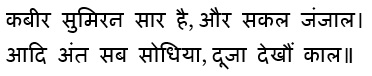
Kabir Sumiran Saar Hai, Aur Sagal Janjal
Aadi Ant Sab Sodhiya, Dooja Dekhon Kaal
Translation
Kabir, remembrance is the essence;
All else is entanglement.
Having examined everything from beginning to end,
I see all else as subject to Time.
My Understanding
Kabir draws our attention to Sumiran — remembrance with attention — as the fundamental principle of living.
Life is a continuum of activity. Even while we sleep, numerous functions within our body continue without our conscious intervention. The heart beats, the lungs breathe and the digestive system performs its functions. An inherent order governs these activities. In a broader sense, we may understand this as inherent remembrance. A disruption of this order can have serious, even fatal, consequences.
Our conscious activities, however, demand our participation. Whether we are writing, cooking, driving or attending to any other task, remembrance of the requisite knowledge and attention to its application are essential. A lapse in attention, despite possessing the necessary knowledge, can lead to errors and failures.
Inherent remembrance sustains Life. Conscious remembrance with attention sustains our endeavors in Life.
What, then, constitutes Janjal?
Consider someone engaged in diverse creative activities — writing poetry, essays and stories, creating illustrations and maintaining correspondence. If all the material is indiscriminately saved in a single computer folder, retrieving a particular item may eventually become a cumbersome exercise. However, by consciously organizing the material into appropriate folders, the same multiplicity of engagements becomes manageable.
What appears on the surface to be an exercise in organization is, in essence, an application of Sumiran. Multiplicity itself is not Janjal. Disorganized multiplicity becomes Janjal. The attention exercised today saves Time tomorrow; the inattention of today may become the entanglement of tomorrow.
The significance of Sumiran, however, extends beyond the efficient execution of our tasks. It encompasses an awareness of the entirety of Existence within which our activities take place.
Guru Nanak says in Japji Sahib:
Amrit Vela Sach Naaon, Vadiyayee Vichar.
Karmi Aave Kapda, Nadri Mokh Dwar.
What is this magnificence that Guru Nanak invites us to contemplate? The five elements, the diversity of nature, the functioning of our own bodies, our parents, our children, our relationships and the innumerable interdependencies that sustain Life — in essence, the entirety of Existence.
Contemplation leads to understanding. Understanding informs our actions. Our actions have consequences, and our conduct cultivates receptivity to Grace.
Guru Nanak further says:
Hukmi Hovan Aakaar, Hukam Na Kehia Jaee.
Forms come into being through Hukam, whose entirety is beyond articulation. We may discover and understand some of its governing principles, but we remain participants in Hukam, not its architects.
Kabir's concluding observation brings into perspective the significance of Kaal — Time. What we perceive as a beginning may have been preceded by something beyond our comprehension. What we perceive as an end may merely be the limit of our capacity to measure or perceive.
Our inability to measure Time does not establish its beginning or its end. Yet everything we undertake, acquire and experience unfolds within Time.
Kabir is not advocating withdrawal from the activities of Life, nor is he prescribing Sumiran as an activity separate from living. He is drawing our attention to the fundamental principle that must permeate our every undertaking. When we are immersed in an undertaking, mindful of the integrity of our actions without being preoccupied with their results, the activity itself becomes a source of fulfillment. When dedication becomes a source of joy, Sumiran ceases to be an effort and becomes Sahaj.
Sumiran is the discipline of conscious participation in Life.
More by : Rajender Krishan