Nov 22, 2026
Nov 22, 2026
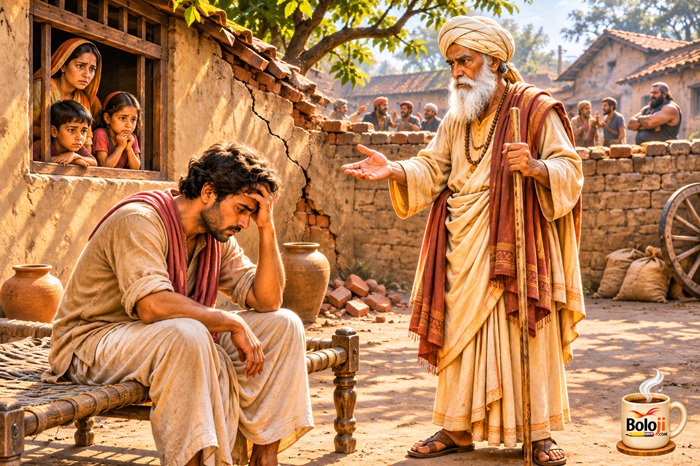
Kabira Teri Jhompri Gal Katiyan Ke Paas
Jo Karenge So Bharenge Tu Kyon Bhayo Udaas

Translation
Kabira, your hut stands beside those of the throat-cutters.
They will pay for their conduct; why are you distressed?
My Understanding
Kabir presents a seemingly simple situation. A householder finds himself living beside people whose conduct may threaten his peace, security, or well-being. The circumstances are not necessarily of his choosing. Nor can he dictate how his neighbors should conduct themselves.
Such situations are hardly unfamiliar to us. In our work-a-day lives, we encounter people whose interests, ambitions, and actions may conflict with our own. Sometimes their conduct is fair and honorable; at other times, it may be ruthless, deceitful, or destructive.
How should we respond?
Kabir reminds us: Jo Karenge So Bharenge. Those who act must bear the consequences of their actions.
Here we recognize the familiar philosophy of Karma—the law of cause and effect. But there is a dimension of Karma that deserves our attention. The consequences of someone's actions do not necessarily remain confined to that person. Their conduct may affect the lives of others, including those who have played no part in their wrongdoing.
A dishonest business practice may threaten another person's livelihood. Betrayal within a family may disturb relationships across generations. Irresponsible decisions by those in authority may affect countless innocent people. The Karma belongs to those who act, but its consequences may reach far beyond them.
And this brings us to Kabir's concluding question:
Tu Kyon Bhayo Udaas?
Why are you distressed?
I do not understand this as an expression of fatalistic resignation, or as comforting reassurance that the wrongdoers will eventually pay for their conduct. To me, Kabir is asking a blunt and candid question.
You recognize your circumstances. You understand the conduct of those around you. You know that their actions have consequences, and that those consequences may affect you.
Then
Being aware of another person's Karma does not absolve us of responsibility for our own. Indeed, our response to circumstances created by others becomes part of our own Karma. We may choose to confront a situation, seek protection, establish boundaries, change our course, or exercise deliberate restraint. Each circumstance calls for its own understanding and judgment.
Even choosing not to act may have consequences.
This does not mean that every misfortune can be prevented through vigilance, or that those who suffer from another's wrongdoing are responsible for their suffering. It simply reminds us that awareness must not end in passive observation when responsible action is possible.
Nor does courage require us to become ruthless in dealing with ruthless people. Our conduct must remain answerable to our own conscience. Perhaps this is where Kabir's question becomes especially relevant to contemporary life.
We spend considerable time worrying about what others are doing, questioning their motives, condemning their conduct, or waiting for them to face the consequences of their actions.
Meanwhile, we may overlook the choices and responsibilities awaiting us. The challenge is not to remain indifferent to wrongdoing. It is to recognize its implications without allowing distress to overwhelm our capacity to respond wisely.
For me, the two lines of this doha are inseparable.
The first presents our situation and circumstances.
The second acknowledges the Karma of others while questioning our own response.
Their Karma may create circumstances that affect us. How consciously we respond becomes part of our own Karma.
And Kabir does not prescribe the answer. He leaves us with a question.
Why are you distressed?
Translate and Awake!
More by : Rajender Krishan
